

TL;DR:
- Accreditation verifies a degree’s quality and eligibility for loans, employment, and further education.
- Regional accreditation ensures better credit transfer and recognition compared to national accreditation.
- For business and accounting, AACSB is the most respected programmatic accreditor globally.
Not all degrees are created equal, and most students only discover this painful truth after graduation. A degree from an unaccredited institution may look identical on paper, but employers, licensing boards, and foreign governments can reject it outright. Accreditation in higher education is a peer-review process conducted by non-governmental organizations that ensures programs meet recognized quality standards, unlocking access to federal student aid and signaling genuine credibility. This guide breaks down what accreditation is, how it works, and exactly what to look for if you are pursuing a fast-track, internationally recognized management or accounting degree.
Table of Contents
- What is accreditation and why does it matter?
- Inside the accreditation process: How institutions earn recognition
- Types of accreditation: Institutional, regional, national, and programmatic
- Specialized accreditors for management and accounting: What to know
- Global perspectives: US vs. international accreditation models
- Our perspective: What most guides miss about accreditation
- Discover your fast-track path with accredited global programs
- Frequently asked questions
Key Takeaways
| Point | Details |
|---|---|
| Accreditation signals quality | Only accredited colleges and programs guarantee recognized degrees and access to financial aid. |
| Types impact career mobility | Regional and programmatic accreditations are critical for international transfer and professional licensure. |
| Management and accounting need specialization | Look for AACSB, ACBSP, or IACBE accreditation in business/accounting for career and CPA eligibility. |
| Global recognition varies | US and international accreditation systems differ; always confirm the accreditor’s global standing. |
| Verify before applying | Check accreditor listings and documentation to avoid costly mistakes with non-recognized programs. |
What is accreditation and why does it matter?
Accreditation is the formal stamp of educational quality that determines whether your degree holds real-world weight. At its core, it is a peer-review process conducted by non-governmental accrediting organizations to ensure institutions and programs meet acceptable levels of quality, enabling access to federal student aid and signaling credibility to students and employers.
Think of accreditation like a kitchen health inspection. A restaurant can claim it follows safety standards all it wants, but without the official inspection certificate on the wall, customers and regulators have no reason to trust it. Accreditation works the same way for your degree.
Here is why it matters so much for your career and finances:
- Financial aid access: Without institutional accreditation, students cannot receive US federal financial aid. This is not a small detail; billions of dollars in grants and loans flow only to accredited programs.
- Employer recognition: Hiring managers and HR departments at global corporations routinely screen candidates by institution type. An unaccredited degree can trigger automatic disqualification.
- Credit transfer: If you decide to continue studying at a different university, accredited schools generally only accept credits from other accredited institutions.
- Licensure eligibility: In fields like accounting, accreditation is often a legal requirement to sit for professional exams, including the CPA exam.
- Graduate school entry: Reputable master’s programs and MBA schools almost always require applicants to hold degrees from accredited undergraduate institutions.
“Accreditation gives students, families, and employers a reliable signal that an institution or program has been independently evaluated and meets established quality benchmarks.” This is not just a bureaucratic requirement. It is the difference between a degree that opens doors and one that closes them.
Understanding how degree accreditation and careers are linked is especially vital for international students who plan to work across borders after graduating. Choosing accredited online programs from the start saves enormous time, money, and frustration down the line.
Inside the accreditation process: How institutions earn recognition
Many students assume accreditation is a one-time formality. It is not. The accreditation process involves self-evaluation by the institution, peer review by experts, site visits, and decisions on granting, reaffirming, or withdrawing accreditation, typically on 5 to 10 year cycles with interim monitoring.
Here is how the process unfolds step by step:
- Self-study: The institution conducts a thorough internal review, examining everything from faculty qualifications and student outcomes to financial stability and curriculum relevance. This document often runs hundreds of pages.
- Submission to the accrediting body: The self-study is submitted to the relevant accrediting organization, which assigns a team of trained peer reviewers drawn from similar institutions.
- Peer review: External reviewers analyze the self-study against established standards. They look for consistency, evidence of student learning, and institutional integrity.
- Site visit: A team physically visits the campus or, increasingly, conducts virtual visits to verify that the reality matches the self-study report.
- Decision: The accrediting commission reviews the full body of evidence and makes a formal decision. Accreditation can be granted to a new institution, reaffirmed for an existing one, or withdrawn if standards are not met.
- Interim monitoring: Even after accreditation is granted, institutions must submit regular progress reports and comply with spot checks. Standards are not static.
- Renewal cycle: Every 5 to 10 years, institutions go through the full process again, ensuring ongoing quality rather than a one-time achievement.
This cyclical model is what makes accreditation meaningful. It is not a trophy you earn once and display forever. Institutions must keep improving to maintain their status.
Pro Tip: When evaluating a program, ask the admissions team when the school was last accredited or reaffirmed, not just whether it holds accreditation. A school due for renewal in the next year may be facing scrutiny. Recent reaffirmation is a much stronger signal of current quality.
Building accredited qualifications for career mobility into your education plan from day one is the smartest insurance policy you can take out on your future earning potential.

Types of accreditation: Institutional, regional, national, and programmatic
Once you understand the process, you need to understand the landscape. Not all accreditation is equal, and the type of accreditation a school holds can significantly affect your options.
| Type | Covers | Best for | Transferability |
|---|---|---|---|
| Regional institutional | Entire institution | Traditional universities, credit transfer | High |
| National institutional | Entire institution | Vocational, for-profit schools | Low |
| Programmatic | Specific programs (e.g., business) | Licensing, specialized careers | Varies by accreditor |
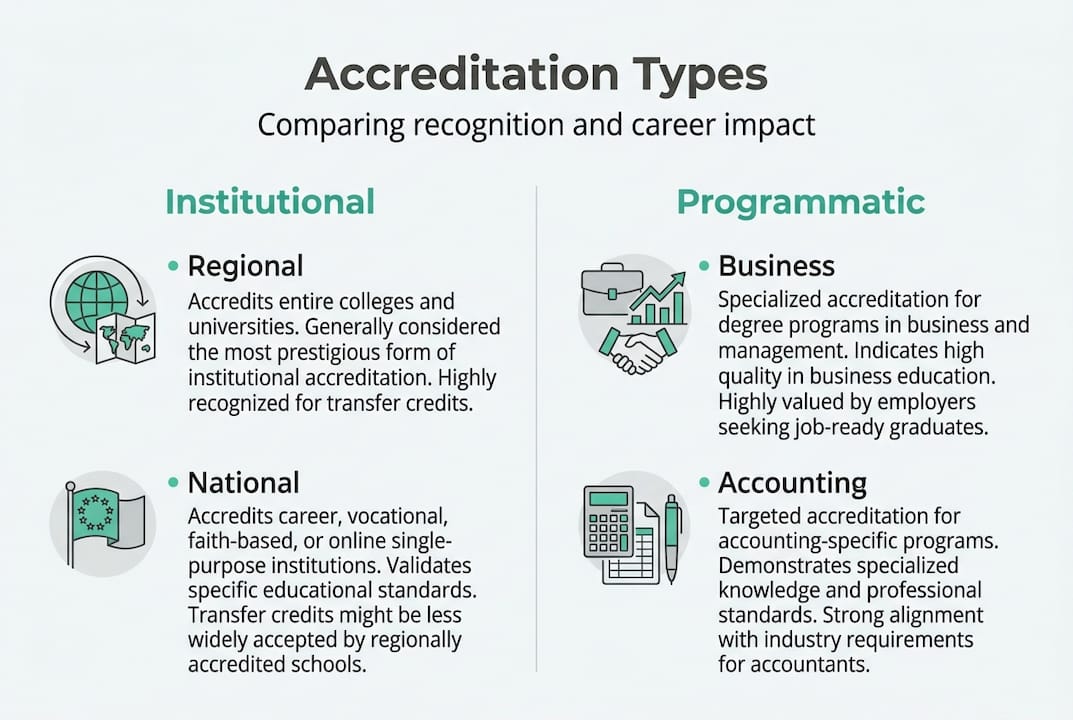
Types of accreditation include institutional (whole institution, regional or national), programmatic (specific programs like business or accounting), with regional preferred for transferability and employer recognition.
Here is what each type means in practice:
- Regional institutional accreditation is the gold standard for traditional four-year colleges and universities. Credits earned at regionally accredited schools transfer freely between institutions, and graduate programs overwhelmingly require it.
- National institutional accreditation often applies to for-profit colleges, vocational schools, and some online institutions. Credits from nationally accredited schools frequently do not transfer to regionally accredited programs. This is a significant hidden risk.
- Programmatic accreditation targets specific academic disciplines. For business and accounting students, this type is critical because it is often tied directly to professional licensing and global recognition.
“An unaccredited degree or one from a nationally accredited institution seeking to transfer to a regionally accredited university may find their credits rejected entirely, forcing students to repeat coursework and spend additional years and tuition dollars.”
This is one of the least-discussed risks in higher education. Students pursuing fast-track degrees need to be especially vigilant about this distinction. When you investigate a business school’s accreditation, always confirm which type of accreditation applies and whether it matches your career and transfer goals.
Specialized accreditors for management and accounting: What to know
If you are studying business management or accounting, the question is not just “is this school accredited?” The real question is “accredited by whom?”
For management and accounting programs specifically, three programmatic accreditors carry the most weight globally. Key programmatic accreditors are AACSB (the gold standard, research-focused, with fewer than 6% of business schools worldwide holding this status), ACBSP (focused on teaching excellence), and IACBE (outcomes-based and mission-driven).
Here is a breakdown of what each means for your career:
| Accreditor | Focus | Global Recognition | Best for |
|---|---|---|---|
| AACSB | Research and rigor | Highest | Global employers, top MBA programs |
| ACBSP | Teaching quality | Strong | Career-focused business graduates |
| IACBE | Mission and outcomes | Growing | Smaller institutions, regional focus |
- AACSB (Association to Advance Collegiate Schools of Business) accreditation is extraordinarily selective. Less than 6% of the world’s business schools hold it, making it a powerful differentiator on any resume. Employers at multinational firms often filter specifically for AACSB-accredited graduates.
- ACBSP (Accreditation Council for Business Schools and Programs) emphasizes teaching quality and student outcomes rather than pure research output. This makes it highly relevant for professional degree programs focused on practical skills.
- IACBE (International Accreditation Council for Business Education) takes a mission-driven, outcomes-based approach, making it well-suited to schools that emphasize applied learning and community impact.
For accounting students specifically, programmatic accreditation is not optional, it is a career prerequisite. Most state CPA boards require that candidates graduate from specifically accredited programs. Studying at an unaccredited program can legally bar you from sitting for the CPA exam, regardless of how strong your grades are.
Pro Tip: If you plan to pursue CPA licensure or want to work for a Big Four accounting firm internationally, verify that your program holds AACSB accreditation or is explicitly recognized by the relevant national accounting body before you enroll.
The rise of accounting automation is reshaping which accounting roles survive and grow. Accredited programs are more likely to update curricula to reflect these industry shifts, another reason accreditation matters beyond just the credential itself.
For students exploring online accounting studies, verifying programmatic accreditation early in the search process is a non-negotiable first step.
Global perspectives: US vs. international accreditation models
Accreditation is not a universal system. If you are studying internationally or planning to work across borders, understanding the differences between national models is essential.
In the United States, accreditation relies almost entirely on private, independent organizations rather than government agencies. There are approximately 85 recognized accreditors, and in 2024, federal aid reached 9.9 million students totaling $120.8 billion, all flowing only through accredited institutions. This figure alone illustrates the financial stakes of accreditation status.
Other countries use very different models:
- United Kingdom: The Quality Assurance Agency (QAA) handles oversight, and degrees are regulated by sector-recognized bodies. UK degrees from Ofqual-regulated institutions carry significant international recognition.
- Singapore: The Committee for Private Education (CPE) regulates private education providers, and many top Singapore programs partner with globally recognized UK or Australian universities for degree validation.
- European Union: Most EU countries use government ministries to oversee accreditation, meaning degrees are state-validated rather than privately accredited.
- Australia: The Tertiary Education Quality and Standards Agency (TEQSA) governs quality, and Australian degrees are broadly recognized across Asia-Pacific and globally.
Key numbers to know:
In 2024, US federal student aid distributed $120.8 billion to 9.9 million students, every dollar of which required the recipient to attend an accredited institution.
For international students, the most important thing to verify is whether your chosen school’s accreditors are recognized by both the US Department of Education (USDE) and the Council for Higher Education Accreditation (CHEA). These two bodies serve as the gatekeepers for recognized accreditation in the US system.
Understanding UK degree recognition is particularly valuable for students who want a degree that carries weight across multiple continents. Students interested in a structured international study experience combining UK-regulated learning with study in Singapore or other global hubs should pay close attention to how their program’s accreditation maps to their target job markets.
Our perspective: What most guides miss about accreditation
Most articles on accreditation tell you what it is. Very few tell you where students actually get burned.
Here is the uncomfortable reality we see repeatedly: students choose programs based on price, convenience, or brand marketing, and only discover accreditation gaps after they have paid tuition and graduated. By then, the damage is done. A degree that cannot transfer, a CPA application that gets rejected, a job offer that evaporates after a background check. These outcomes are not hypothetical. They happen to real students every year.
The national versus regional distinction is perhaps the single most underexplained issue in higher education guidance. Schools with national accreditation are not “almost regionally accredited.” They are in a completely different category, and treating them as equivalent is a mistake that can cost years of academic progress.
We are also skeptical of taking an institution’s word on accreditation status. School websites can be outdated, misleading, or technically accurate in a narrow sense while omitting important context. Our firm advice is to verify directly through USDE or CHEA databases, which are publicly searchable and updated regularly. Do not skip this step even if a school has impressive testimonials and a polished website.
Global employers, especially multinational firms hiring across the US, UK, Asia, and Australia, are becoming significantly more rigorous in credential verification. The days when any accredited degree passed automatic scrutiny are fading. Recruiters at top firms now distinguish between AACSB and non-AACSB business programs, especially for management and finance roles.
Finally, accreditation standards are not frozen. They evolve in response to industry changes, technology, and labor market demands. This means a program that was well-aligned with accreditation standards five years ago may be falling behind today. Choosing a school committed to continuous improvement, one that embraces the cyclical reaffirmation process enthusiastically, protects you from credential drift.
For students serious about degree recognition for careers that span borders and industries, treating accreditation as an afterthought is simply not an option in 2026.
Discover your fast-track path with accredited global programs
If this guide has done its job, you now know that accreditation is not a bureaucratic checkbox. It is the foundation of a degree that actually works for your career, your licensure goals, and your international ambitions.
At Seekstudy, we built our programs specifically for students who want accredited, internationally recognized degrees without sacrificing speed or flexibility. Our partnerships with UK, Singapore, Hong Kong, and Australian institutions mean your qualification carries genuine global weight. Whether you are exploring a business management degree or looking for fast-track preparation in management and accounting, you can start your journey knowing that every program we offer is built on verified, recognized accreditation. Your next step toward a credible, career-ready degree starts here.
Frequently asked questions
How can I verify a program’s accreditation status?
Check the USDE or CHEA searchable databases directly and request official accreditation documentation from the school’s admissions office before enrolling.
Why is regional accreditation preferred over national?
Regional accreditation offers far better credit transfer and recognition, while nationally accredited credits often cannot transfer to regionally accredited universities, limiting your future academic and career options.
Which accreditor should I look for in business and accounting programs?
Look for AACSB, ACBSP, or IACBE; AACSB is the gold standard for business and accounting programs globally and carries the strongest recognition among top employers and graduate schools.
Does accreditation affect my eligibility for federal aid?
Yes, only students enrolled at accredited institutions can access US federal financial aid, which distributed $120.8 billion to 9.9 million students in 2024.
How does US accreditation compare globally?
The US uses private independent accreditors while most other countries rely on government-led systems, so international transferability depends on mutual recognition agreements between specific accrediting bodies and national education authorities.