

TL;DR:
- Accelerated management and accounting degrees are shorter, often 2-3 years, saving time and money.
- Admission requires transcripts, English tests, credit evaluations, recommendations, and accreditation verification.
- Choosing accredited programs, understanding financial options, and assessing personal readiness are crucial for success.
Choosing a fast-track Management or Accounting degree as an international student can feel like solving a puzzle with half the pieces missing. Which programs are real? What do you actually need to apply? How do you pay for it without relocating your entire life? These are fair, urgent questions, and most university websites answer them in the vaguest possible way. This guide cuts through the noise. You’ll get a step-by-step breakdown of accelerated program types, application requirements, cost strategies, flexible study options, and the most common mistakes to avoid, so you finish with a clear, actionable plan.
Table of Contents
- Understanding accelerated degree options and formats
- Essential requirements: Application, credits, and English tests
- Financing your degree: Tuition, cost-saving strategies, and scholarships
- Maximizing your study experience: Flexible pathways and global options
- Avoiding common mistakes and ensuring your qualification counts
- A fresh perspective: What most university guides overlook for fast-track international students
- Explore your fast-track options with SeekStudy
- Frequently asked questions
Key Takeaways
| Point | Details |
|---|---|
| Accelerated program formats | Fast-track Management and Accounting degrees let you finish in 2-3.5 years with flexible, online, or global options. |
| Entry requirements | You’ll need transfer credits, language testing, and accredited programs for the biggest advantage. |
| Smart financing | Look for scholarships and credit transfers; faster programs can cost much less overall. |
| Global experience options | Fully online or hybrid models enable international study without a relocation barrier. |
| Pitfalls to avoid | Verify accreditation, plan time carefully, and use creative networking to maximize program value. |
Understanding accelerated degree options and formats
Not all fast-track degrees are the same, and the differences matter more than most students realize. An accelerated program compresses the traditional timeline by increasing course intensity, allowing year-round enrollment, or accepting significant transfer credits. Some programs also use competency-based education (CBE), where you advance by demonstrating mastery of skills rather than sitting through set hours of instruction.
For Management and Accounting specifically, here’s what the timelines typically look like:
| Degree Level | Traditional Duration | Accelerated Duration |
|---|---|---|
| Bachelor’s in Business Management | 4 years | 2 to 3 years |
| Bachelor’s in Accounting | 4 years | 2.5 to 3.5 years |
| Master’s/MBA | 2 years | 1 to 1.5 years |
Accelerated online degrees in management and accounting typically take 2.5 to 3.5 years for bachelor’s programs, with some business master’s programs completable in under 2 years. That’s a significant saving of both time and tuition.
The format you choose shapes your entire experience. Here are the main options:
- Fully online: Study from anywhere, no visa required, maximum flexibility for working students.
- Hybrid: A mix of online coursework and short on-campus intensives, often held in a partner country.
- International or ‘Go Global’ tracks: You complete core modules online, then spend a semester on campus in a partner city like Singapore or the UK.
International students are drawn to these models for very practical reasons. There’s no need to uproot your life or secure a long-term visa. Costs tend to be lower overall. And you still earn a recognized qualification from an accredited institution. Exploring an accelerated bachelor’s degree or comparing online vs on-campus formats can help you pinpoint which structure fits your situation best.
Essential requirements: Application, credits, and English tests
With a clear picture of program types, you’re ready to focus on what you’ll need to apply and succeed.
Getting into an accelerated program involves more moving parts than a standard application. Missing even one element can delay your enrollment by a full semester. Here’s a numbered checklist to keep you organized:
- Academic transcripts from all previous institutions, officially translated if required.
- Proof of English proficiency (IELTS, TOEFL, or program-accepted equivalent).
- Transfer credit evaluation to determine how much of your prior study counts.
- Personal statement or statement of purpose focused on your professional goals.
- Letters of recommendation from academic supervisors or employers.
- Application fee payment and deadline tracking across programs.
Transfer credits are one of the most powerful accelerators available. Most programs accept up to 90 to 93 transfer credits, which can shave off a full year of study. The catch is that not all credits transfer automatically. Credits from unaccredited institutions or unrelated fields may be rejected, so get a formal credit evaluation early.

For English proficiency, typical minimum scores are:
| Test | Minimum Score (Common Range) |
|---|---|
| IELTS Academic | 6.0 to 6.5 |
| TOEFL iBT | 79 to 90 |
| PTE Academic | 55 to 65 |
Accreditation is another non-negotiable. Programs accredited by bodies like AACSB, ACBSP, or Ofqual carry real weight with employers. A degree from an unaccredited school may not be recognized at all in your home country or target job market. Always check the business school accreditation before applying, and review the full university entry guide to make sure nothing falls through the cracks.
Pro Tip: If you’ve worked in accounting, finance, or management for several years, ask about Prior Learning Assessment (PLA). Some programs grant credits for professional experience, which can reduce your required coursework significantly.
Financing your degree: Tuition, cost-saving strategies, and scholarships
Once you know the requirements, you’ll need a financial plan that matches the fast timeline and international scope.
Cost is often the biggest hesitation for international students. The good news is that accelerated formats are inherently cost-efficient. You pay for fewer semesters, spend less time away from work, and avoid years of living expenses abroad.
Here’s a rough cost comparison:
| Program Type | Cost Range |
|---|---|
| Accelerated online accounting bachelor’s | $330 to $600 per credit |
| Accelerated online master’s in accounting | From $14,170 total |
| One-year MBA (online) | Varies by institution |
Faster completion directly reduces the number of semesters you pay for, which is a real financial advantage beyond just the per-credit rate. A two-year program versus a four-year program at the same per-credit cost still saves you two full years of fees.
To make financing work, consider these strategies:
- Transfer credits: Every credit that transfers is one you don’t have to pay for again.
- Employer tuition assistance: Many companies offer tuition reimbursement for employees pursuing business degrees. Check your HR policy.
- External scholarships: Organizations like Rotary International, regional government funds, and private foundations offer scholarships specifically for international students.
- Institutional aid: Many accredited online programs offer merit-based scholarships or fee waivers for early applicants.
- Online-only savings: No campus housing, no commuting costs, no international travel required for most coursework.
Pro Tip: When applying for financial aid, organize every document before deadlines open. Schools often process aid on a first-come, first-served basis. A well-prepared application submitted early consistently outperforms a stronger application submitted late.
Maximizing your study experience: Flexible pathways and global options
Financing secured, you’re ready for the flexible choices and global advantages these programs can unlock.
Choosing between a fully online program and a hybrid or international track comes down to what you want your degree to do for you beyond the certificate itself.
Online-only programs give you the purest flexibility. You study on your schedule, from any country, without visa concerns. This works best if you’re employed, have family responsibilities, or are in a region with limited campus access. The tradeoff is reduced in-person networking and fewer structured internship pathways.
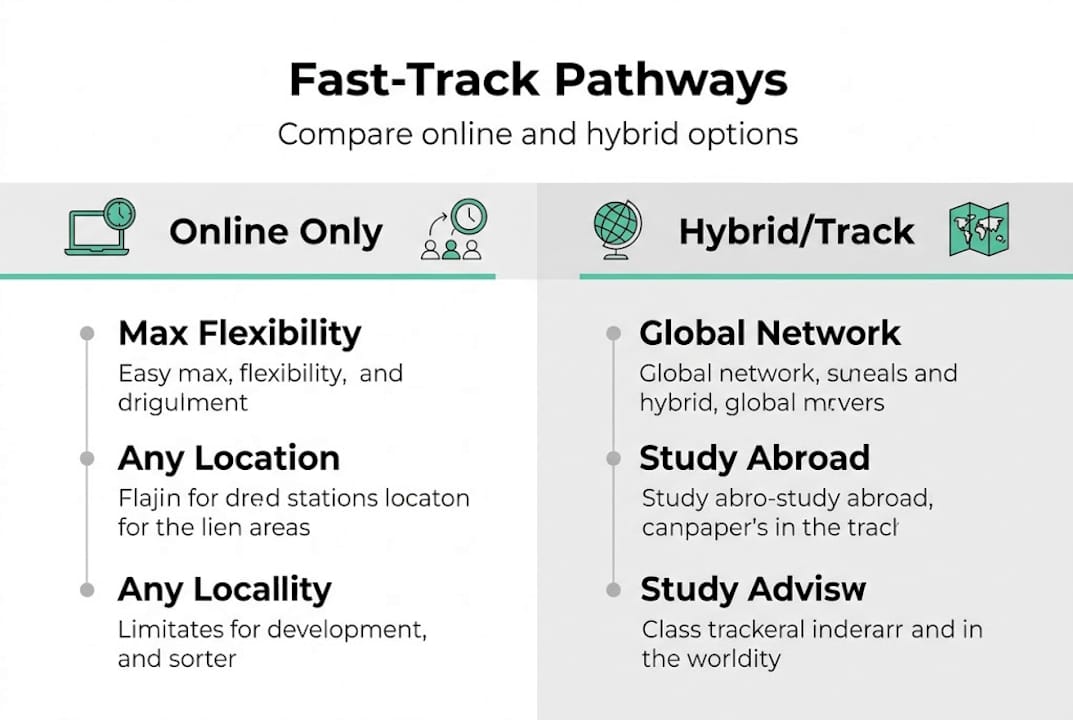
Hybrid and international track programs introduce you to a global peer network. Options like international study experiences in Singapore or the UK give your resume a dimension that fully remote graduates don’t always have. You gain cross-cultural communication skills, face-to-face alumni connections, and often access to regional job markets.
No-visa online programs are ideal for international students who cannot commit to relocating, while hybrid tracks like international campus options provide structured global exposure without a full campus commitment.
Here’s a quick pros and cons breakdown:
- Online-only pros: Flexibility, lower cost, no relocation, work-compatible.
- Online-only cons: Less networking, fewer formal internship pipelines.
- Hybrid/international pros: Global peers, campus immersion, employer prestige.
- Hybrid/international cons: Higher cost, travel required, more scheduling complexity.
Pro Tip: If you choose a fully online format, build your network intentionally. Attend virtual industry events, join LinkedIn alumni groups for your program, and participate actively in online cohorts. Networking effort separates average online graduates from standout ones.
For a full breakdown of how to navigate study abroad components within accelerated timelines, the fast-track online abroad guide covers practical logistics in detail.
Avoiding common mistakes and ensuring your qualification counts
Understanding pathways and program options, you’re now equipped to sidestep common pitfalls for long-term success.
The most expensive mistake an international student can make is enrolling in a program that isn’t recognized where they plan to work. Here are the top errors to avoid:
- Choosing an unaccredited program. No matter how polished the website looks, always verify business school accreditation through the accrediting body’s official directory.
- Underestimating the pace. Accelerated programs cover the same content in less time. Expect a heavier weekly workload than you’re used to.
- Ignoring transfer credit deadlines. Many students lose eligible credits by submitting transcripts late.
- Skipping prerequisite courses. Some programs require foundational accounting or math courses before you can enroll in upper-level modules.
- Overvaluing prestige, undervaluing fit. A highly ranked school with poor student support for international learners will underserve you.
On accreditation outcomes, research shows that program choice affects career results significantly, even among AACSB-accredited schools. Where you study matters, but so does how well the program is designed for your specific situation.
“The compressed schedule of accelerated programs requires more self-direction than most students anticipate. Those who succeed treat the program as a full-time professional project from day one.”
Verifying recognition is straightforward. Check whether the awarding institution is listed in your country’s national qualifications framework. For UK-awarded degrees, Ofqual regulation is a clear marker of legitimacy. Exploring accelerated degrees career boost research can also help you understand realistic outcomes by program type.
A fresh perspective: What most university guides overlook for fast-track international students
Most guides walk you through the mechanics of fast-track degrees, checklists, costs, accreditation, and then stop. What they rarely address is whether you, specifically, are ready for what the daily reality of compressed study actually demands.
Accelerated programs are not just faster versions of standard degrees. They require a different relationship with time, stress, and uncertainty. Many students enroll expecting efficiency and encounter intensity instead. That’s not a problem with the program. It’s a mismatch between expectation and preparation.
Personal adaptability matters as much as accreditation. A degree from a recognized institution delivered through fast-track degree programs built around global peer cohorts can deliver outcomes that rival or exceed traditional programs when the student is genuinely committed. But students who enroll just to finish faster often struggle with the discipline required.
The honest question to ask yourself before enrolling: Do I have the maturity, structure, and motivation to replace the natural pacing of a four-year program with self-imposed discipline over two? If yes, fast-track is an excellent strategic choice. If you’re still developing those habits, a foundation or preparation course first may serve you far better than jumping straight into the accelerated track.
Explore your fast-track options with SeekStudy
Ready to put your plan into action? SeekStudy specializes in flexible, globally recognized Management and Accounting degrees designed specifically for students who want to move faster without sacrificing credential quality.
Whether you’re exploring fast-track business degrees at the bachelor’s level, comparing accelerated management and accounting programs across countries, or looking for a structured international study experience combining Singapore and the UK, SeekStudy gives you the tools to compare, decide, and enroll with confidence. Regulated by Ofqual and partnered with institutions across the UK, Hong Kong, Singapore, and Australia, every program is built around your goals and timeline.
Frequently asked questions
How long does it take to complete an accelerated online management or accounting degree?
Most bachelor’s programs take 2.5 to 3.5 years, while some business master’s programs can be finished in under 2 years depending on transfer credits and enrollment pace.
Are there scholarships for international students enrolling in online fast-track programs?
Yes. Many universities offer merit-based scholarships and financial aid for online and international degree seekers, and external scholarship programs from foundations and governments add further options.
Do online degrees offer the same recognition as campus degrees?
If a program is AACSB, ACBSP, or Ofqual accredited, online degrees are recognized by employers worldwide at the same level as traditional campus credentials.
What are the main challenges of fast-track online study?
The intensity is the primary challenge. Accelerated programs demand strong time management, and you’ll have fewer structured in-person networking and internship opportunities compared to traditional campus programs.
Can I get transfer credit for previous study or work experience?
Most programs accept up to 90 to 93 transfer credits from prior study, and some schools also grant credits for professional experience through Prior Learning Assessment programs.