

TL;DR:
- Accreditation provides external validation ensuring program quality and long-term career benefits.
- Accredited, field-relevant credentials typically offer a wage premium of around 3.8%.
- Accreditation signals global recognition, aiding international mobility and meeting licensure and visa requirements.
Many professionals spend years and thousands of dollars on credentials that barely move the needle on their salary or career trajectory. The uncomfortable reality is that near-zero employment effects are documented for some qualifications, while accredited ones consistently drive long-run value. So what separates a credential that opens doors from one that collects dust on your resume? The answer almost always comes back to accreditation. Understanding what accreditation actually means, what research says about its benefits, and how to use it strategically can completely change the return you get on your education investment.
Table of Contents
- What does accreditation really mean?
- The proven benefits: What research says about accredited qualifications
- Beyond the badge: How accreditation drives career mobility and global opportunities
- When is an accredited qualification the right choice?
- What most guides miss about accredited qualifications
- Ready to take the next step with an accredited qualification?
- Frequently asked questions
Key Takeaways
| Point | Details |
|---|---|
| Accreditation signals quality | Independent accreditation assures employers and universities that your qualification meets rigorous international standards. |
| Career and wage impact | Relevant accredited credentials are linked to higher long-term earnings and greater global mobility. |
| Critical for transfers | Accredited qualifications are often required for degree transfers, professional licensing, and international opportunities. |
| Consider your goal | Weigh formal recognition needs against personal, sector, and skill development priorities before choosing a program. |
What does accreditation really mean?
Accreditation is one of those terms that gets thrown around constantly in education marketing, but rarely explained clearly. At its core, accreditation is an external validation process. An independent body, recognized by governments or international quality networks, evaluates whether a program or institution meets defined standards for curriculum, faculty qualifications, student outcomes, and assessment practices.
This is not a one-time rubber stamp. Accredited qualifications go through rigorous, ongoing review processes that include self-evaluation reports, peer review panels, and sometimes physical site visits. Programs must also align with ESG standards, which stands for Education Standards Governance, a framework that ensures consistent quality across institutions.
Here is what a typical accreditation process involves:
- Self-evaluation: The institution documents its own performance against defined benchmarks
- Peer review: External academic and industry experts assess the evidence
- Site visits: Reviewers may visit campuses or observe online delivery systems
- Outcome monitoring: Graduate employment rates, student satisfaction, and learning results are tracked over time
- Periodic renewal: Accreditation is not permanent and must be maintained
“Accreditation provides a quality signal that neither employers nor universities can easily replicate through informal assessment. It is the foundation of trust in higher education.”
The contrast with unaccredited programs is significant. An unaccredited program may deliver excellent content, but without external verification, employers and universities have no reliable way to assess its quality. Understanding business school accreditation helps clarify why this distinction matters so much in management and accounting fields specifically.
For working professionals considering accredited online programs, the good news is that accreditation methodology has evolved to cover flexible and fast-track delivery formats. Distance learning, blended programs, and accelerated degrees can all achieve full accreditation when they meet the same outcome standards as traditional formats. The mode of delivery is less important than whether the outcomes and assessments hold up to scrutiny.
The proven benefits: What research says about accredited qualifications
Now that accreditation is clear, what does research actually tell us about the tangible benefits?
The evidence is strong, but it comes with an important nuance: the gains from accreditation tend to build over time rather than appearing immediately after graduation. A meta-analysis on accreditation found that accredited higher education consistently improves institutional quality across infrastructure, faculty development, and curriculum design, and these improvements translate into measurable long-term wage gains for graduates.
One of the most actionable findings comes from wage premium research. Job-relevant credentials yield a 3.8% wage premium compared to just 1.8% for credentials that are not aligned with the holder’s field. That gap compounds significantly over a career spanning decades.
| Credential type | Average wage premium | Global recognition | Transfer eligibility |
|---|---|---|---|
| Accredited, field-relevant | 3.8% | High | Yes |
| Accredited, field-irrelevant | 1.8% | Moderate | Yes |
| Unaccredited, any field | Near 0% | Low | Rarely |
What does this look like in practical terms? Here are the types of gains you can realistically expect from an accredited qualification:
- Salary growth: Compounding wage premiums that widen the earnings gap over 10 to 20 years
- Career mobility: Eligibility for roles that require verified credentials
- Global recognition: Acceptance by employers and institutions across multiple countries
- Further study access: Entry into postgraduate programs that require accredited undergraduate degrees
- Professional licensing: Meeting requirements for regulated professions in fields like accounting and finance
Pro Tip: The field relevance factor is critical. Earning an accredited qualification in a discipline directly tied to your target role amplifies the wage premium significantly. Choosing a fast-track degree in business management or accounting, for example, positions you for both the accreditation signal and the field-relevance bonus.
The research also confirms something that surprises many adult learners: the short-term employment advantage of accreditation is modest. What accreditation does is build a foundation for sustained career growth, not just a quick hiring boost. Exploring the value of accredited online programs in more depth can help you set realistic expectations and plan your timeline accordingly.

Beyond the badge: How accreditation drives career mobility and global opportunities
Understanding the data helps. But how does this translate into global career and study opportunities?
Accreditation is essentially a universal language in higher education. When your qualification carries recognized accreditation, institutions and employers in other countries can assess its value without needing to investigate the program from scratch. This matters enormously if you plan to work internationally, apply for skilled migration visas, or transfer credits toward a higher degree.
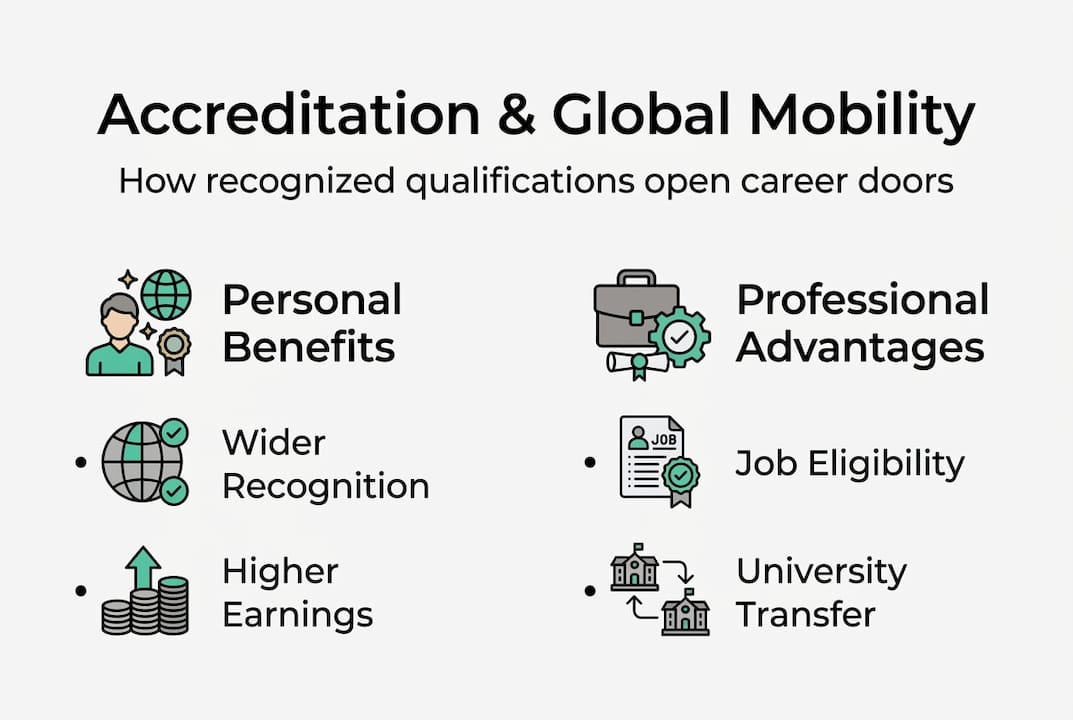
Accreditation signals quality to employers across borders, enhancing credibility and mobility, though the effects are not always immediate or identical in every market. Some sectors, like financial services, healthcare management, and public administration, treat accreditation as a baseline requirement. Others, particularly in technology startups or creative industries, may weight portfolio evidence more heavily.
| Factor | Accredited qualification | Unaccredited qualification |
|---|---|---|
| University transfer eligibility | Typically accepted | Often rejected |
| Professional licensing | Usually qualifies | Frequently disqualified |
| Visa and migration points | Counts toward skilled categories | May not be recognized |
| Employer trust signal | Strong and immediate | Requires additional verification |
| International recognition | Broad and consistent | Varies widely |
Understanding the global meaning of UK-recognized degrees is particularly relevant here. UK-accredited qualifications carry weight in Commonwealth countries, parts of Asia, and increasingly in the Middle East and Africa, making them a strong choice for professionals seeking cross-border mobility.
Pro Tip: Before enrolling in any program, check the specific accreditation requirements of your target employer, destination country, or licensing body. Requirements vary. An accreditation that satisfies an employer in Singapore may not automatically satisfy a licensing board in Canada. Researching your international study experience options early helps you align your choice with your actual destination goals. You can also compare international study options to find the right fit for your career trajectory.
One common pitfall is assuming that all accreditation is equivalent. Regional accreditation, national accreditation, and professional body accreditation each carry different weight depending on context. Always verify which type applies to the program you are considering.
When is an accredited qualification the right choice?
So, is pursuing an accredited path always necessary? Let’s make it practical.
The honest answer is: not always, but more often than most people realize. Here is a step-by-step way to decide whether accreditation should be a non-negotiable for your situation:
- Check your field requirements. Regulated professions like accounting, law, and healthcare management typically require accredited credentials for licensure. If your field is regulated, accreditation is not optional.
- Consider your career change goals. Switching industries often requires external validation that your skills meet a recognized standard. An accredited qualification provides that proof in a way that a short course cannot.
- Factor in visa and migration plans. Many skilled migration programs award points specifically for qualifications from accredited institutions. If you plan to relocate, this can be decisive.
- Ask your target employers directly. Many job listings now specify accreditation requirements. If you see “degree from a recognized institution” in a job description, that almost always means accredited.
- Assess your timeline and goals. If you need a qualification quickly for a promotion or visa application, a fast-track degree program that is also accredited offers the best of both worlds.
That said, unaccredited programs are not always the wrong choice. If your goal is personal development, entrepreneurship, or highly specialized technical upskilling where employers care only about demonstrated skill, an unaccredited program may serve you well. However, unaccredited qualifications often limit your ability to transfer credits or meet licensure requirements, which can become a problem later.
Pro Tip: Watch for accreditation badges on job application forms and listings. When an employer specifically asks for an accredited degree, they are filtering applicants at the screening stage. A non-accredited qualification will not clear that filter regardless of its content quality.
A quick checklist before enrolling:
- Is the awarding body listed on an official national or international quality register?
- Does the program meet the requirements of your target employer or licensing body?
- Will the qualification be recognized if you move to a different country?
- Does the value of the UK degree or equivalent align with your career destination?
What most guides miss about accredited qualifications
With those practical tools, let’s reflect on what’s often missing from advice about the value of accreditation.
Most articles treat accreditation as a binary: you either have it or you don’t, and having it is always better. That framing misses something important. Accreditation is a door-opener, not a finish line. We have seen professionals with fully accredited degrees struggle because the qualification was misaligned with their actual goals, and we have seen others with non-traditional credentials thrive because they built skills that employers genuinely needed.
The real question is not just “is this accredited?” but “is this accredited qualification the right fit for where I am going?” Employers increasingly care about adaptability, applied skill, and proven outcomes. Accreditation signals that your education met a verified standard, but it does not replace the work of demonstrating what you can actually do.
For adult learners and working professionals, the smartest move is to treat accreditation as a necessary baseline in most cases, then layer in field relevance, program flexibility, and international recognition on top. That combination is what genuinely moves careers forward. If you are considering earning a UK degree abroad, for instance, the accreditation question and the international recognition question are inseparable and both deserve careful research.
Ready to take the next step with an accredited qualification?
Armed with this clarity, you may be considering your own next steps. At Seekstudy, we offer fast-track, internationally recognized programs designed specifically for working professionals who cannot afford to pause their careers for years of full-time study.
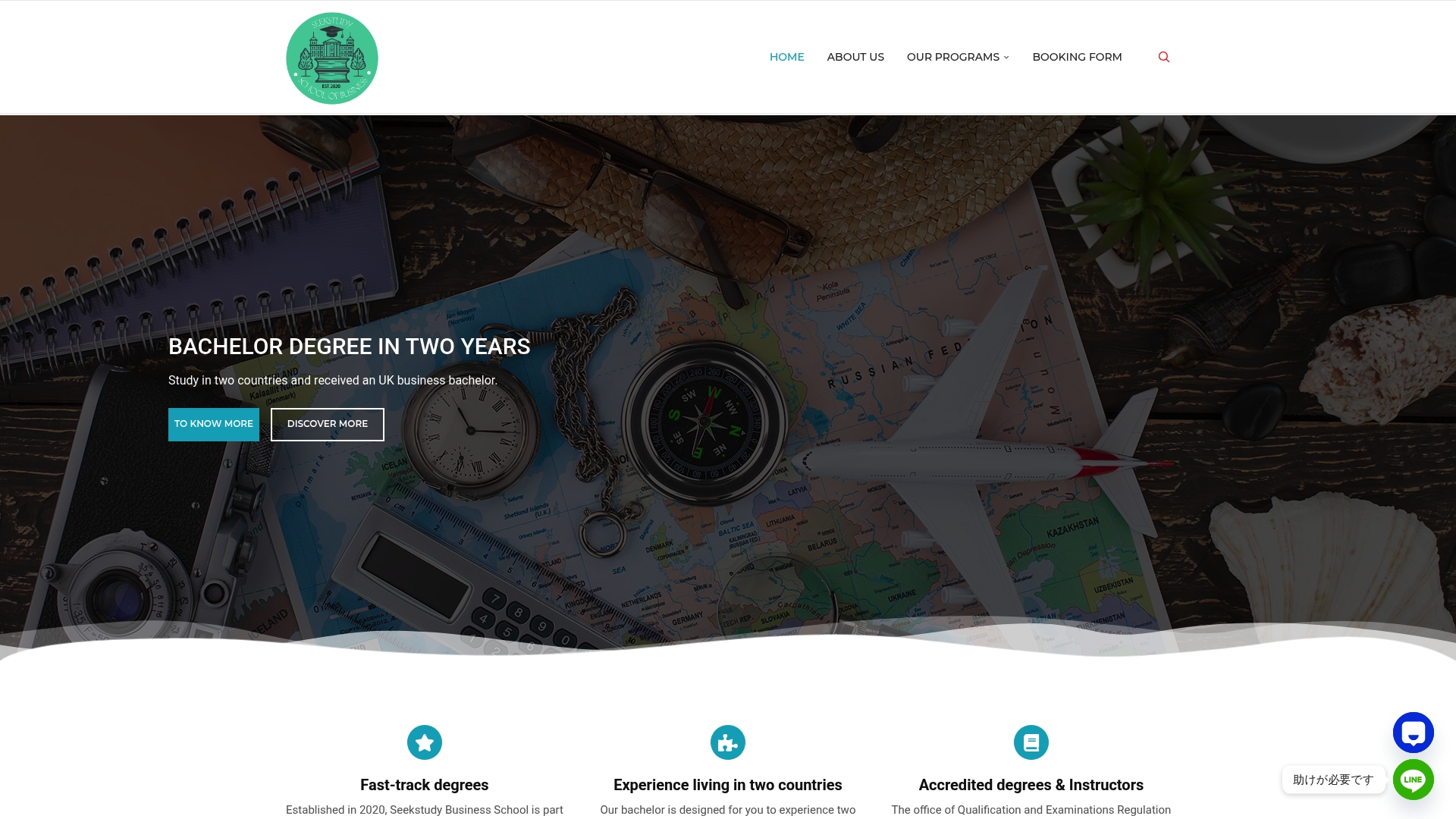
Our accelerated business degrees combine UK-recognized accreditation with flexible online delivery and real international study experiences. Whether you are exploring the benefits of an online MBA or looking for a structured online MBA for professionals, our programs are built to meet the standards that employers and institutions worldwide recognize. Explore your options and see how an accredited qualification can fit your timeline and career goals.
Frequently asked questions
What is an accredited qualification?
An accredited qualification is officially recognized by an external quality-assurance body, ensuring that its content and assessment meet internationally accepted standards. This recognition is what allows employers and universities to trust the credential without independently verifying the program.
Do accredited qualifications guarantee a better job?
They strongly improve long-term career outcomes and recognition, but accreditation boosts long-run wages rather than guaranteeing an immediate employment advantage in every sector. The gains compound over time, especially when the credential is field-relevant.
How do I check if a qualification is accredited?
Look for validation from official accrediting agencies listed on government or international quality registers, and confirm the rigorous review process on the awarding institution’s website. You can also contact the relevant professional body in your field to verify recognition.
When might an unaccredited program be a good choice?
If you prioritize speed, skill-specific learning, or entrepreneurship and are not seeking formal recognition, unaccredited options can sometimes make sense. However, unaccredited qualifications often limit your ability to transfer credits or meet licensure requirements down the line.