

Choosing the right qualification can shape your future, especially when career growth depends on earning a degree with global recognition. For ambitious international students, a UK-recognized degree stands out due to its strong government oversight and worldwide credibility. If you want a Management or Accounting degree that opens international doors yet lets you study flexibly online from home, understanding what sets UK-recognized degrees apart is key for making an informed decision.
Table of Contents
- What Defines A UK-Recognized Degree
- Types Of UK-Recognized Degrees Explained
- Accreditation And Quality Assurance Frameworks
- How To Verify Degree Recognition Status
- Key Benefits For International Students
- Common Misconceptions And Pitfalls To Avoid
Key Takeaways
| Point | Details |
|---|---|
| UK-Recognized Degrees | Represent internationally validated credentials and are subject to rigorous academic standards and quality assurance. |
| Verification Process | It’s crucial to verify the institution’s degree-awarding status and recognition to ensure global transferability and professional credibility. |
| Degree Types | UK-recognized degrees include undergraduate and postgraduate options, each serving distinct academic and professional needs. |
| Common Misconceptions | Understanding the value of degrees and their recognition is critical; not all degrees guarantee employment or universal acceptance. |
What Defines a UK-Recognized Degree
A UK-recognized degree represents more than just an academic qualification – it’s an internationally validated credential with significant career implications. These degrees are distinguished by rigorous academic standards and comprehensive quality assurance processes that ensure global recognition and professional credibility.
To qualify as a UK-recognized degree, the qualification must meet specific criteria established by official regulatory bodies. Academic standards set by QAA determine whether an institution can legally confer genuine UK degrees. These standards encompass several critical dimensions:
- Institutional Accreditation: Must be awarded by a formally recognized degree-awarding institution
- Quality Assurance: Subject to strict government regulation and external assessment
- Academic Rigor: Demonstrates high-level independent thinking and analytical skills
- Professional Validity: Meets employment and professional registration requirements
The key differentiator for UK-recognized degrees is their robust evaluation process. Government-regulated assessment methods include comprehensive examinations, plagiarism checks, and stringent academic review. These mechanisms ensure that graduates possess not just theoretical knowledge, but practical competencies valued by employers worldwide.
Beyond technical requirements, UK-recognized degrees cultivate distinctive professional attributes. They emphasize critical thinking, research capabilities, and self-directed learning – skills that transcend traditional academic boundaries and prepare students for complex global challenges.
Pro tip: Before committing to a degree program, verify the institution’s official degree-awarding powers and international recognition status to maximize your educational investment.
Types of UK-Recognized Degrees Explained
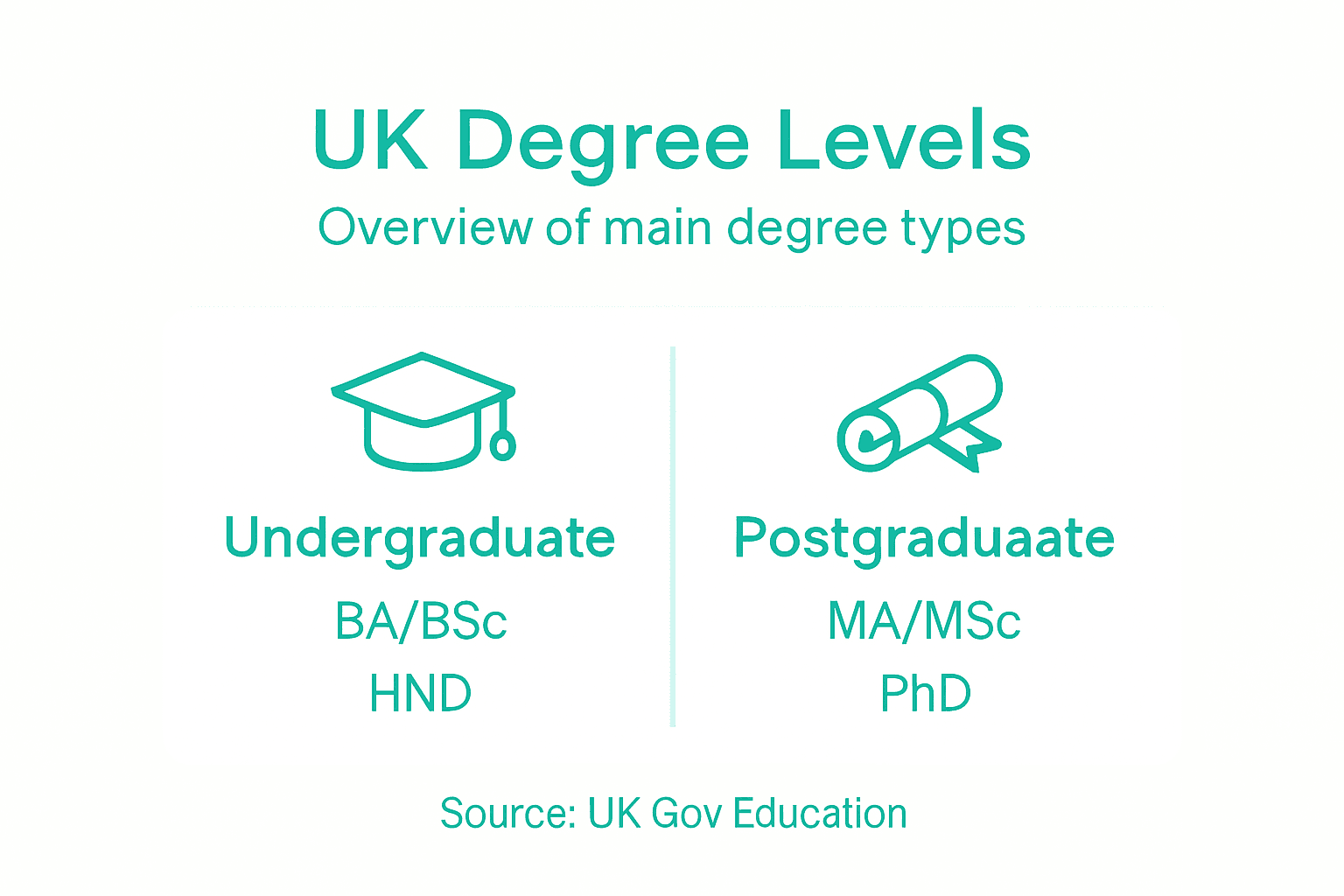
The landscape of UK-recognized degrees encompasses a diverse range of academic qualifications designed to meet various professional and academic aspirations. Undergraduate and postgraduate degrees represent a comprehensive educational framework that supports students across multiple disciplines and career paths.
Undergraduate degrees form the foundation of UK academic qualifications, typically including:
- Bachelor of Arts (BA): Humanities and social science disciplines
- Bachelor of Science (BSc): Scientific and technical fields
- Bachelor of Engineering (BEng): Engineering and technological specializations
- Foundation Degrees: Two-year programs providing practical vocational training
Postgraduate opportunities expand beyond bachelor’s level, offering more specialized and advanced study options. These include:
- Taught Master’s Degrees: One to two-year programs with structured coursework
- Research Master’s Degrees: Emphasizing independent research and academic exploration
- Integrated Master’s: Four-year programs combining bachelor’s and master’s level study
- Doctoral Degrees (PhD): Highest academic qualification focusing on original research
Degree Classification adds another layer of complexity to UK academic credentials. Honours degrees are categorized into distinct classes that reflect academic performance:
- First Class: Outstanding academic achievement
- Upper Second (2:1): Strong academic performance
- Lower Second (2:2): Satisfactory academic achievement
- Third Class: Minimum passing standard
These nuanced classifications provide employers and academic institutions with detailed insights into a graduate’s academic capabilities, beyond simple pass/fail metrics.

Here’s a comparison of undergraduate, postgraduate, and doctoral UK-recognized degrees to clarify their unique focus and duration:
| Degree Level | Primary Emphasis | Typical Duration |
|---|---|---|
| Undergraduate | Foundational knowledge, skills | 3-4 years full-time |
| Postgraduate | Advanced specialization | 1-2 years full-time |
| Doctoral (PhD) | Original research contribution | 3-5 years full-time |
Pro tip: Always verify the specific accreditation and recognition status of your chosen degree program to ensure global transferability and professional credibility.
Accreditation and Quality Assurance Frameworks
The integrity of UK higher education hinges on robust accreditation and quality assurance mechanisms that protect academic standards and ensure global recognition. UK Qualifications Frameworks establish comprehensive guidelines that govern the structure, learning outcomes, and assessment criteria for academic programs across different levels.
The Quality Assurance Agency (QAA) plays a pivotal role in maintaining these standards through multiple evaluation processes:
- Institutional Review: Comprehensive assessment of university academic standards
- Degree Awarding Powers Verification
- Periodic Programmatic Assessments
- External Examination Systems
- Qualification Level Standardization
Key frameworks define specific expectations for different academic levels, creating a structured approach to educational quality:
- Undergraduate Framework: Specifies knowledge acquisition and skill development
- Postgraduate Framework: Emphasizes advanced research and specialized knowledge
- Doctoral Framework: Focuses on original research contributions
- Professional Qualification Standards: Ensures alignment with industry requirements
The QAA’s framework represents a gold standard in maintaining academic excellence and ensuring that UK degrees meet rigorous international benchmarks.
These frameworks are not static documents but dynamic systems that evolve with changing educational landscapes. They provide a comprehensive mechanism for:
- Maintaining academic integrity
- Ensuring consistent educational quality
- Supporting student learning outcomes
- Facilitating international degree recognition
- Protecting student and institutional interests
Pro tip: Always request official QAA documentation when evaluating the credibility of an academic institution or degree program.
How to Verify Degree Recognition Status
Verifying the authenticity and recognition of a UK degree is crucial for international students and professionals seeking global career opportunities. Official degree verification platforms provide comprehensive mechanisms to validate academic credentials and prevent potential fraudulent claims.
Key steps for confirming degree recognition include:
- Check Official Government Registers
- Verify recognized awarding bodies on official UK government websites
- Confirm the institution’s legal status for degree awarding
- Validate credentials across England, Northern Ireland, Scotland, and Wales
- Use Centralized Verification Services:
- Higher Education Degree Datacheck (HEDD)
- National Recognition Information Centre (UK NARIC)
- Professional regulatory body databases
Comprehensive verification requires multiple cross-reference points to ensure complete academic credential validation.
The verification process typically involves several critical documentation checks:
- Original degree certificate
- Academic transcripts
- Institutional accreditation evidence
- Individual consent for verification
- Potential additional professional certification requirements
International students and professionals should be prepared to provide:
- Complete personal identification
- Original academic documents
- Potential translation certifications
- Payment for verification services
- Consent forms for background checks
Pro tip: Always maintain digital and physical copies of your academic credentials and start the verification process well in advance of critical application deadlines.
Use this reference table to understand key agencies that ensure UK degree recognition and quality:
| Agency/Service | Main Role | When to Use |
|---|---|---|
| QAA | Maintains academic quality standards | Evaluating institutions |
| HEDD | Central degree verification | Confirm credentials |
| UK NARIC/ENIC | Compares international qualifications | Overseas degree checks |
Key Benefits for International Students
UK-recognized degrees offer international students a transformative educational experience that extends far beyond traditional academic training. World-class education from respected universities provides a strategic pathway to global career opportunities and personal development.
Key advantages for international students include:
- Enhanced global employability
- Advanced critical thinking skills
- Internationally recognized credentials
- Comprehensive English language proficiency
- Extensive professional networking opportunities
The professional benefits of UK degrees are particularly significant:
- Global Career Opportunities
- Professional Credential Recognition
- Competitive Skill Development
- International Work Pathways
UK qualifications are universally respected, providing students with a competitive edge in increasingly complex global job markets.
International students gain substantial advantages through professional qualification recognition that transcends geographical boundaries. These degrees are designed to meet rigorous international standards, ensuring graduates can seamlessly transition between academic and professional environments.
Professional attributes developed through UK educational frameworks include:
- Advanced analytical capabilities
- Cross-cultural communication skills
- Independent research methodologies
- Strategic problem-solving approaches
- Adaptable professional mindsets
Pro tip: Research specific international professional accreditations associated with your chosen degree to maximize long-term career potential.
Common Misconceptions and Pitfalls to Avoid
Navigating the landscape of UK-recognized degrees requires careful understanding and strategic planning. Debunking prevalent myths about degree value is crucial for international students seeking meaningful educational experiences.
Common misconceptions include:
- All degrees are equally valuable
- UK degree automatically guarantees employment
- Degree classification doesn’t matter
- Professional registration is automatic
- Foreign degrees are universally recognized
Key pitfalls international students should be aware of:
- Overlooking accreditation requirements
- Misunderstanding degree equivalency
- Assuming universal professional recognition
- Neglecting additional certification needs
- Underestimating institutional differences
Not all degrees are created equal – rigorous research and strategic planning are essential for maximizing educational investments.
Foreign degree recognition involves complex processes that require proactive verification. Students must understand that holding a degree does not automatically translate to professional qualification or immediate employability.
Specific challenges international students might encounter include:
- Complex professional registration processes
- Varying institutional accreditation standards
- Different evaluation criteria for international qualifications
- Additional certification requirements
- Potential language and cultural competency assessments
Pro tip: Consult official recognition agencies and conduct comprehensive research before committing to an international degree program.
Achieve a Truly UK-Recognized Degree That Opens Global Doors
Navigating the complex world of UK-recognized degrees can feel overwhelming. You want to be certain your degree holds the professional credibility, rigorous quality assurance, and international recognition so vital for career success. SeekStudy understands these challenges and offers fast-track, fully accredited UK bachelor’s and master’s degrees designed to meet global standards. Our programs combine practical management and accounting expertise with authentic UK credentials, supported by Coventry London Campus Archives – SeekStudy Business School | and international learning opportunities.

Take control of your academic future today with SeekStudy. Benefit from accelerated degree programs that emphasize critical professional skills and global employability. Explore flexible online learning combined with international study experiences to maximize your investment in a UK-recognized qualification. Discover all the options and start your journey now at SeekStudy. To learn more about study destinations that match your ambitions, visit our Destinations Archives – SeekStudy Business School |.
Frequently Asked Questions
What is a UK-recognized degree?
A UK-recognized degree is an academic qualification that meets strict standards set by regulatory bodies in the UK, ensuring credibility and international recognition, and is awarded by accredited institutions.
How can I verify if my degree is UK-recognized?
You can verify if your degree is UK-recognized by checking official government registers, centralized verification services like Higher Education Degree Datacheck (HEDD), and by confirming your institution’s accreditation status with appropriate bodies.
What are the different types of UK-recognized degrees?
UK-recognized degrees include undergraduate degrees such as Bachelor of Arts and Bachelor of Science, postgraduate degrees like taught and research master’s degrees, and doctoral degrees (PhD), each designed for varying levels of specialization and study duration.
What benefits do UK-recognized degrees offer to international students?
UK-recognized degrees provide international students with enhanced global employability, advanced critical thinking skills, internationally recognized credentials, and extensive networking opportunities, preparing them for successful careers worldwide.
Recommended
- Home – SeekStudy Business School |
- Study in Singapore and UK – SeekStudy Business School |
- Executive MBA – SeekStudy Business School |
- Post-Graduate Diploma in Strategic Management and Leadership – SeekStudy Business School |
- Diploma e Riconoscimento Internazionale: Guida Completa – Recupero Anni Scolastici e Diploma Online