

Many international students assume university entry requirements are a wall built to keep them out. They’re not. They’re more like a checklist, and with the right preparation, most motivated applicants can meet them, even for competitive business management and accounting programs. This guide breaks down exactly what universities look for, how your international qualifications stack up, and what makes fast-track and online programs a realistic option. Whether you’re coming from a traditional academic background or switching careers mid-stream, you’ll walk away knowing precisely what to do next and what to stop worrying about.
Table of Contents
- Understanding university entry requirements: The basics
- Types of qualifications accepted around the world
- Special considerations for fast-track and flexible online programs
- Tips to strengthen your application as an international student
- What most guides miss about university entry requirements
- Unlock your business management degree with SeekStudy
- Frequently asked questions
Key Takeaways
| Point | Details |
|---|---|
| Entry requirements explained | Universities usually set guidelines for academic scores, English proficiency, and key documents. |
| Global qualifications accepted | Many universities recognize international diplomas—check their official equivalency charts. |
| Fast-track options available | Flexible and accelerated programs can count your work experience toward admission. |
| Application tips matter | Personal statements, references, and clear documentation help you stand out as an international applicant. |
| Persistence pays off | If you have gaps or unique credentials, contact universities directly—context can make all the difference. |
Understanding university entry requirements: The basics
University entry requirements are the minimum standards a school sets to determine whether an applicant is ready for degree-level study. They exist to protect students as much as institutions. Admitting someone who isn’t prepared sets them up to struggle, so requirements are designed to predict academic success, not to exclude.
For most undergraduate business, management, and accounting programs, you’ll typically need to provide:
- Academic transcripts showing your secondary school or prior university grades
- Proof of English proficiency via a recognized test like IELTS or TOEFL
- A personal statement explaining your goals and motivation
- Reference letters from teachers, employers, or mentors
- A copy of your passport or national ID for identity verification
As UCAS outlines, universities assess English proficiency, academic transcripts, and other factors for admissions. What surprises many international students is that these components carry different weight depending on the institution and program type.
“Entry requirements are not a single fixed standard. They vary by country, degree level, and even by the specific university department reviewing your file.”
One of the biggest misconceptions is that qualifications from one country simply won’t transfer. In reality, most universities have formal processes for evaluating international credentials. Your Bachelor’s degree qualifications from your home country are rarely dismissed outright. They’re reviewed against established equivalency frameworks.
Another common confusion: students think a rejection means permanent exclusion. Most universities allow reapplication, appeals, or alternative entry routes. The online degree application process at many institutions is also more flexible than the traditional paper-based route, giving you more time and support to get your documents right.
For a broader picture of what international applicants face, the international student admissions guide from QS Top Universities is a solid starting point that breaks down expectations by region.
Types of qualifications accepted around the world
Once you understand what’s required, the next challenge is showing how your qualifications measure up, especially if you’ve studied in another country.
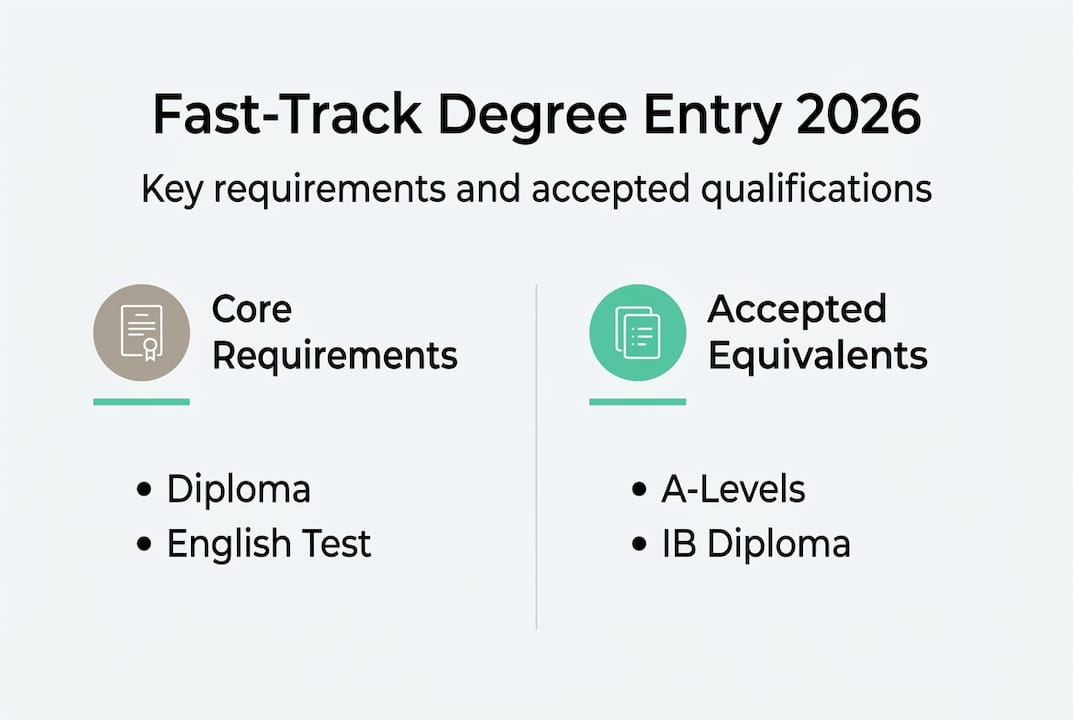
The term “equivalent qualification” refers to a credential from your home country that reaches the same academic level as what the destination university expects. For UK universities, this often means matching the standard of A-levels. For US schools, it’s typically a high school diploma with a strong GPA. For Singapore and Australian institutions, each has its own benchmark, but all recognize a broad range of international credentials.
Here’s how common qualifications compare for business and management entry:
| Qualification | Country of origin | Typical equivalency |
|---|---|---|
| A-levels (3 subjects) | United Kingdom | Direct entry to bachelor’s |
| International Baccalaureate (IB) | International | Widely accepted globally |
| High school diploma + SAT | United States | Accepted at most UK/Singapore universities |
| STPM or SPM | Malaysia | Reviewed case-by-case, often accepted |
| Gaokao | China | Accepted at select UK and Australian universities |
| CBSE / HSC | India | Accepted with strong scores |
As study-in-uk.com notes, many UK and US universities list country-specific equivalencies for international credentials. This means you don’t have to guess. You can look up exactly where your qualification sits.
For students pursuing UK-recognized degrees, this equivalency process is straightforward because UK institutions have decades of experience evaluating global credentials. Understanding the global degree value of your qualification helps you target the right programs from the start.
Pro Tip: Use a credential evaluation service like WES (World Education Services) or your target university’s own equivalency tool to get an official assessment before you apply. This saves time and removes guesswork from the process.
For a full breakdown by country, the country-specific entry requirements resource from QS is one of the most detailed publicly available guides.
Special considerations for fast-track and flexible online programs
Traditional routes aren’t the only path. Many students benefit from alternatives tailored for today’s lifestyles.
“Fast-track” means a degree program compressed into a shorter timeframe, typically two years for a bachelor’s instead of three or four, by removing long summer breaks and increasing study intensity. These programs often recognize prior learning, meaning work experience or previous study can count toward your degree credits.

Here’s how fast-track and online entry requirements compare to traditional programs:
| Requirement | Traditional program | Fast-track or online program |
|---|---|---|
| Academic qualifications | A-levels or equivalent | Secondary diploma or equivalent |
| Work experience | Usually not required | Can substitute for some qualifications |
| English proficiency | IELTS or TOEFL required | Same, but some offer pre-entry English support |
| Age requirement | Typically 18+ | Often 21+ for mature entry routes |
| Application timeline | Fixed annual intake | Rolling or multiple intakes per year |
According to Study International, fast-track programs often offer alternative pathways and credit for work experience. This is a game-changer for working professionals who have real-world skills but may not have a perfect academic record.
The flexible learning pathways available today reflect a broader shift in higher education toward recognizing diverse forms of learning. Enrollment in online and accelerated degree programs has grown significantly over the past five years globally.
To check if you qualify for a fast-track pathway, follow these steps:
- Review the program’s official entry requirements page
- List your academic qualifications and years of relevant work experience
- Contact the admissions team directly to ask about recognition of prior learning
- Request a pre-application assessment if the school offers one
- Submit a complete application with all supporting documents
Exploring fast-track degree flexibility options early gives you a clearer picture of realistic timelines. You can also use a fast-track entry checklist to make sure your documents are in order before you apply.
Tips to strengthen your application as an international student
Even if you’re eligible, the way you present your background makes a big difference.
Your personal statement is not a formality. It’s your chance to explain who you are, why you want this degree, and why you’re ready for it now. A strong statement connects your past experience to your future goals in a specific, honest way. Generic statements about “passion for business” won’t stand out. Specific examples will.
As UCAS advises, personal statements and references can set applicants apart from peers with similar credentials. This means two students with identical grades can receive different outcomes based purely on how they present themselves.
Here’s a quick list of dos and don’ts for international applicants:
- Do tailor your personal statement to the specific program
- Do get your IELTS or TOEFL score before applying, not after
- Do ask recommenders who know your work ethic, not just your grades
- Don’t submit a generic statement copied from templates
- Don’t leave gaps in your timeline unexplained
- Don’t assume your credentials speak for themselves without context
For students applying to accounting programs specifically, reviewing accounting application tips can help you frame your quantitative skills and career goals more effectively. And if you’re considering a broader international study experience, knowing how to position that ambition in your application adds real strength.
Pro Tip: If you have a career gap, a subject change, or a non-traditional background, address it directly in your personal statement. Admissions teams respect honesty and self-awareness far more than a polished but vague narrative.
The UK university application requirements from the British Council also offer a reliable overview of what UK institutions expect from international applicants at every level.
What most guides miss about university entry requirements
Here’s something most admissions articles won’t tell you: entry requirements are guidelines, not always firm cutoffs. Universities publish minimum standards, but admissions decisions are made by people reviewing full applications, not algorithms scanning for a specific grade.
Context matters enormously. A student from a country with a weaker secondary school system who scores slightly below the listed minimum may still receive an offer because the admissions team understands the academic environment they came from. A student with a perfect transcript but a vague personal statement may not.
The biggest overlooked factor is persistence. Students who contact admissions offices directly, ask clarifying questions, and follow up thoughtfully are remembered. Those who submit and disappear are not. If you’re unsure whether your qualifications meet the threshold, ask. Most schools will tell you honestly.
Personal growth and unique life experience often tip the scale in borderline cases. Exploring international study pathways that align with your background shows you’ve done your research and are serious about the commitment.
Unlock your business management degree with SeekStudy
Now that you know your options and what’s required, here’s how to start your degree journey today.
SeekStudy was built specifically for international and fast-track applicants who want accredited, UK-recognized business and accounting degrees without the rigid timelines of traditional universities. Our team supports you from the first question to the final application, with flexible entry options designed for real life.
You can explore fast-track programs that fit your schedule and background, apply for a business degree with guidance at every step, or review the full online business management degree to see exactly what’s included. The path to your degree is clearer than you think.
Frequently asked questions
What academic qualifications do I need for a fast-track business degree?
You generally need an accredited high school or secondary diploma plus proof of English proficiency, but some programs also consider relevant work experience as credit toward your entry eligibility.
Can I use my country’s high school qualifications to apply to UK or US universities?
Yes. Universities regularly publish official equivalency tables for international students that show exactly which qualifications they accept from each country.
Are university entry requirements different for online and fast-track programs?
Yes. Online and fast-track programs often accept flexible entry qualifications and may award credit for prior study or professional work experience.
What English language tests are accepted for international university entry?
Most universities accept IELTS, TOEFL, or equivalent exams as proof of English proficiency for international applicants.