

Over 90% of study abroad alumni report gaining job-ready skills like adaptability and communication, and more than half credit their time abroad for landing their first role. Yet most people still picture international study as a gap year or a casual exchange semester. It is far more than that. Whether you are a recent graduate targeting a global management career or a working professional looking to fast-track a recognized degree, international study experience is a structured, credit-bearing pathway that reshapes how employers see you and how you see the world. This article breaks down what it really means, who it is for, and how to make it work for your goals.
Table of Contents
- What does international study experience really mean?
- Key benefits: academic, personal, and career growth
- Short-term vs. long-term international programs: what’s the difference?
- Who should pursue international study? Students vs. working professionals
- How to maximize your international study experience
- Explore international study pathways with SeekStudy
- Frequently asked questions
Key Takeaways
| Point | Details |
|---|---|
| Holistic definition | International study experience means earning credit, building skills, and gaining cultural immersion abroad. |
| Major career boost | Over 90 percent of study abroad alumni gain essential job skills and over half say it aided their first job or promotion. |
| Short- and long-term options | Short programs provide career gains rivaling longer stays so find the fit for your goals. |
| Tailored for professionals | RPL and fast-track degrees make global study accessible and valuable for working adults. |
| Barriers are surmountable | Funding, language, and safety can be addressed with targeted preparation and institutional support. |
What does international study experience really mean?
The term gets used loosely, so let’s be precise. International study experience refers to structured programs that let students complete part of their academic work in a foreign country, earning credits while engaging with new cultures, languages, and educational systems. That definition, drawn from study abroad frameworks, immediately separates it from casual travel or a two-week cultural tour.
There are three main formats worth knowing:
- Study abroad programs: You enroll at a foreign institution for one or more semesters, earning transferable credits toward your home degree.
- Exchange programs: Structured and reciprocal, meaning your home school and the host school swap students. Costs are often offset.
- International internships: Work-based placements in a foreign country, sometimes credit-bearing, always career-building.
“International study experience integrates academic rigor with cultural immersion, producing graduates who can navigate complexity across borders, not just within them.”
For business and management students, the study abroad benefits go even further. You are not just attending lectures in a different time zone. You are learning how markets, regulations, and professional norms differ across countries, which is exactly the kind of contextual intelligence that global employers pay a premium for.
Key benefits: academic, personal, and career growth
Understanding what it is sets the stage for why it is so desirable, especially when the data and outcomes are this compelling.
Study abroad alumni data shows that over 90% report building critical job skills, and more than 50% say the experience directly contributed to their first job offer. Those are not soft claims. They are benchmarks that hiring managers in management and accounting roles increasingly recognize.
| Benefit area | What you gain | Real-world impact |
|---|---|---|
| Academic | Cross-system knowledge, credit transfer | Broader degree recognition |
| Personal | Adaptability, resilience, communication | Stronger soft skill profile |
| Career | Global network, employer credibility | Faster promotions, better offers |
Here is what that looks like in practice:
- Adaptability: Navigating a new academic system under pressure builds problem-solving instincts that classroom simulations cannot replicate.
- Global networking: Classmates from 20 countries become professional contacts across industries and continents.
- Employer credibility: Hiring managers in career and employment roles consistently rank international experience as a differentiator for management candidates.
- Cultural intelligence: Understanding how business is conducted in Singapore, the UK, or Hong Kong gives you a practical edge in cross-border negotiations and team management.
For those specifically interested in studying in Singapore, the combination of a high-performing academic environment and a globally connected business hub makes it one of the most strategically valuable destinations for management students. The global career benefits of pairing an international experience with an accredited degree are well documented and growing.

Short-term vs. long-term international programs: what’s the difference?
Not all international experiences are the same. Choosing the right fit means weighing short, targeted programs against immersive, long-term stays.
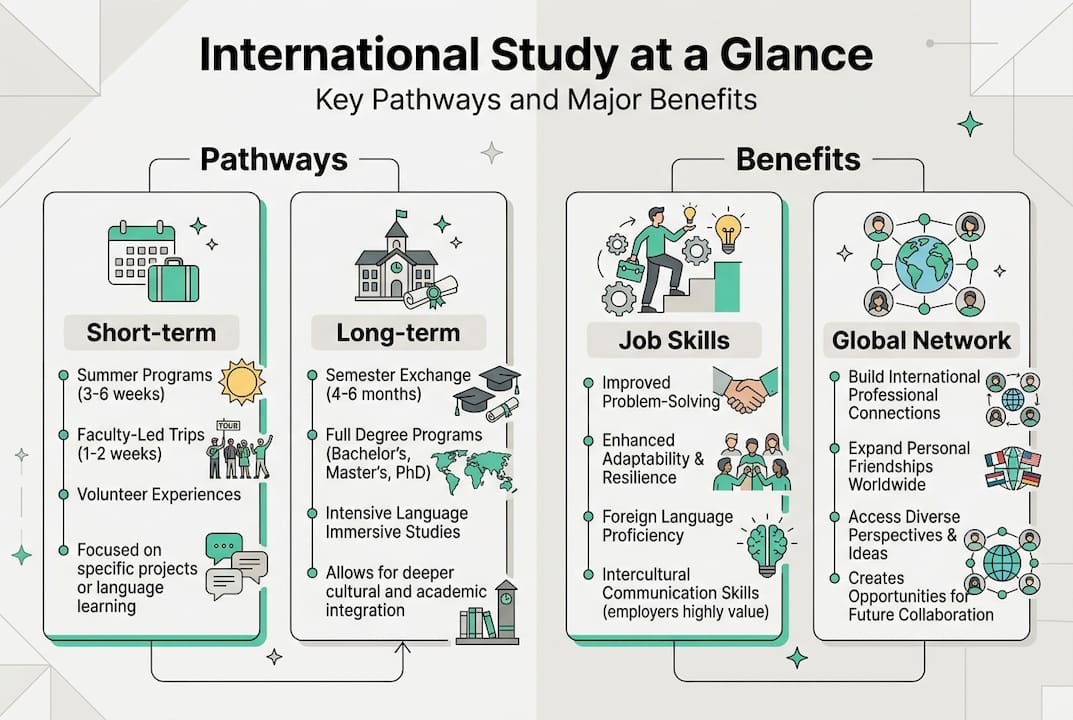
A common misconception is that only year-long programs deliver real results. Research tells a different story. Shorter mobilities like summer schools and intensive modules yield benefits comparable to full-year programs, particularly for working professionals who cannot step away from their careers for 12 months.
| Feature | Short-term (weeks to 3 months) | Long-term (6 months to 2 years) |
|---|---|---|
| Time commitment | Low to moderate | High |
| Cost | Lower overall | Higher, but more aid available |
| Career impact | Strong for skill-building | Strong for immersion and networks |
| Flexibility | High, suits professionals | Lower, suits full-time students |
| Credit options | Sometimes available | Usually fully credit-bearing |
Common barriers include funding, language requirements, and safety concerns. But these are solvable. Many programs offer scholarships, language support, and structured safety frameworks. For accounting and management professionals, Recognition of Prior Learning (RPL) can also reduce the time and cost needed to qualify for advanced programs.
Some overviews of program types highlight that non-degree options are increasingly common and respected by employers, especially when paired with a recognized credential. It is also worth noting that while the data is overwhelmingly positive, some research points out that career returns can vary depending on whether the experience is adventure-focused or career-focused. Intentionality matters.
Pro Tip: Before choosing a program, write down your top three professional goals for the next five years. Then select the program format that directly addresses at least two of them. A short intensive in Singapore may deliver more targeted value than a year abroad with no clear career alignment.
If you want to prepare for studying abroad effectively, start with your end goal and work backward to the program type.
Who should pursue international study? Students vs. working professionals
Once you know the program options, it becomes crucial to assess if and when an international path matches your stage and needs.
International study is not a one-size-fits-all decision. Here are the most common candidate profiles:
- The traditional student: Pursuing a bachelor’s or master’s degree and looking to add global credentials and cultural depth to their academic profile.
- The career switcher: Moving from a domestic role into international business, finance, or management and needing recognized credentials to make the transition credible.
- The upskilling professional: Already working in accounting or management, seeking a fast-track degree or executive qualification to accelerate promotion or expand into new markets.
- The global mobility seeker: Targeting roles in multinational firms or international organizations where a UK-recognized or globally accredited degree is a baseline requirement.
For professionals in the third and fourth categories, RPL pathways are a game-changer. For professionals, RPL allows prior qualifications and work experience to count toward degree entry or even credit exemptions, dramatically reducing the time and cost of earning a recognized credential.
Pro Tip: If you have five or more years of professional experience in management or accounting, check whether your target program offers RPL assessment. You may qualify for advanced entry, saving a full year of study time.
Use the fast-track student checklist to assess your readiness, and review UK degree value explained to understand what a UK-recognized credential means for your career trajectory.
How to maximize your international study experience
Understanding who benefits is only part of the picture. Getting real value requires smart planning and follow-through.
Here is what separates students who transform their careers through international study from those who simply add a line to their resume:
- Match the program to your goals: A summer school in financial regulation serves a different purpose than a two-year business degree in Singapore and the UK. Be specific.
- Plan your finances early: Scholarships, employer sponsorships, and RPL credit reductions can significantly lower costs. Start researching six to twelve months before your target start date.
- Build your network intentionally: Attend every industry event, connect with faculty, and stay in touch with classmates. Your cohort is a global professional network in the making.
- Document your skills as you go: Keep a running record of projects, presentations, and cross-cultural challenges you navigated. These become powerful interview stories.
- Leverage your degree’s recognition: A UK and Europe business degree carries weight in hiring decisions across Asia, the Middle East, and beyond.
“Students who approach international study with clear professional goals consistently report stronger career outcomes than those who treat it as an adventure first and a credential second.”
This aligns with research on short-term mobilities showing that intentional engagement, not just duration, drives the most meaningful results. Whether you spend three weeks or two years abroad, your mindset and preparation determine the return.
Explore international study pathways with SeekStudy
Ready to turn international ambition into a career edge? SeekStudy was built for exactly this moment.
We offer fast-track, accredited programs in business management and accounting that combine online flexibility with real international study experiences, including pathways through Singapore and the UK. Our bachelor in business management can be completed in two years, and our online MBA for professionals is designed for working adults who need a recognized credential without pausing their careers. RPL pathways mean your existing experience counts. If you are serious about accelerated business degrees that open global doors, SeekStudy gives you the structure, the credentials, and the international experience to make it happen.
Frequently asked questions
What is the difference between study abroad and international study experience?
Study abroad typically refers to flexible, independent enrollment at a foreign institution, while international study experience is a broader term covering all structured programs abroad, including exchanges, internships, and credit-bearing intensives. For fast-track degrees, study abroad frameworks also incorporate RPL for qualified professionals, giving it a more career-integrated scope.
Does a short-term international program really help my career?
Yes. Short-term mobilities like summer schools deliver job skill and employability benefits comparable to year-long programs, making them a practical option for professionals who cannot commit to extended study.
How can working professionals benefit from international study?
Professionals can use international programs to fast-track credentials, expand their global network, and accelerate promotions. International work experience is positively linked to promotions and financial success across 30 countries, with short-term experiences proving especially valuable in competitive markets.
What are the main barriers to studying abroad?
Funding, language requirements, and safety concerns are the most commonly cited challenges. Most programs address these through scholarships, language support, and structured safety frameworks, and many barriers can be reduced with early planning and the right program fit.