

TL;DR:
- Accelerated online MBA programs enable professionals to earn degrees in as little as 12 months without leaving their jobs.
- Preparing a strong application requires early organization of transcripts, test scores, recommendations, and tailored essays.
- Success depends on choosing the right program format, maintaining organized tracking, and leveraging shortcuts like networking and program-specific waivers.
Balancing a demanding job while chasing an MBA feels impossible until you realize the rules have changed. Accelerated online MBA programs now let ambitious professionals earn a globally recognized degree in as little as 12 months, without quitting their job or moving abroad. But the application process still trips up thousands of qualified candidates every year, not because they lack credentials, but because they walk in unprepared. This guide breaks down every stage of the online MBA application, from eligibility checks to post-submission troubleshooting, so you can move forward with confidence and speed.
Table of Contents
- Assessing eligibility and preparing key documents
- Navigating program options and choosing the right fit
- Step-by-step application process for online MBA programs
- Verifying application status and troubleshooting frequent issues
- What most guides miss: Real-world shortcuts to MBA application success
- Ready to accelerate your management career?
- Frequently asked questions
Key Takeaways
| Point | Details |
|---|---|
| Prep early for success | Start your online MBA application process today to avoid missing steps or deadlines. |
| Choose the right program | Carefully compare formats, durations, and support before deciding on an accelerated online MBA. |
| Follow stepwise instructions | Break down the application into manageable tasks and use verified timelines for each stage. |
| Verify and troubleshoot | Monitor your application after submission and address common issues for smoother progress. |
| Leverage shortcuts | Business undergraduates and applicants with strategic planning can accelerate their application journey. |
Assessing eligibility and preparing key documents
Before you write a single word of your personal statement, you need to know whether you qualify. Most online MBA programs share a core set of requirements, but accelerated tracks often have slightly different rules that can work in your favor if you know how to use them.
Academic requirements form the foundation. You typically need an undergraduate degree from an accredited institution, and many programs expect a minimum GPA of around 3.0 on a 4.0 scale. However, strong professional experience can offset a lower academic record at many schools. If you want to explore the online MBA application steps in detail, understanding these thresholds early saves you from wasted effort.
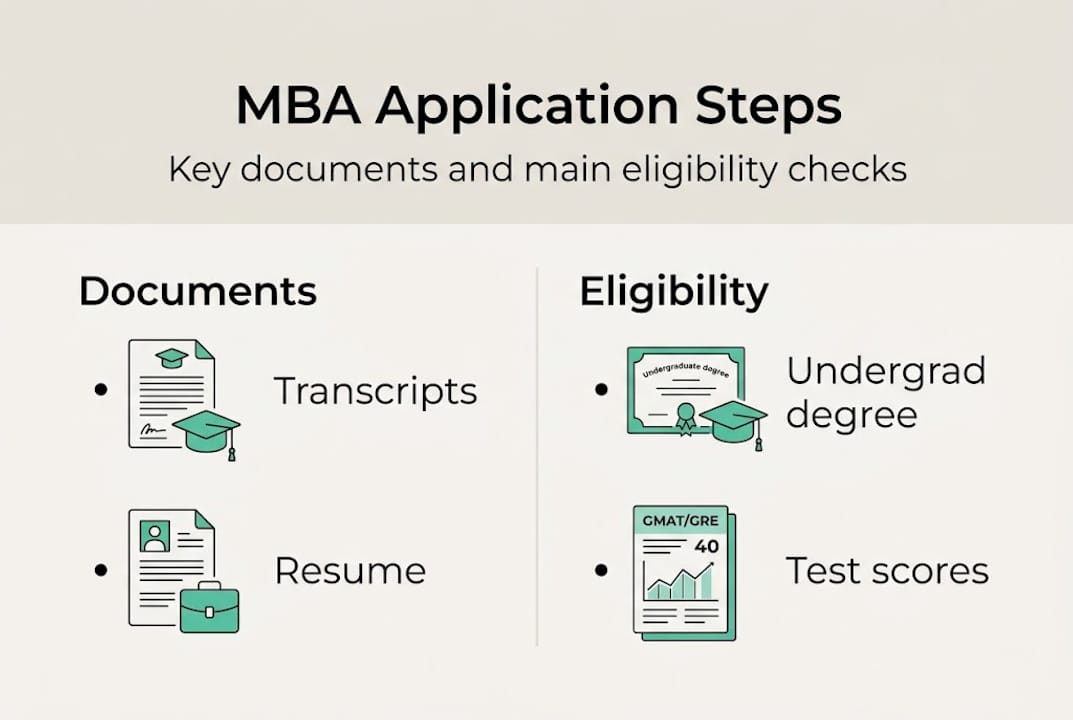
For international applicants, language proficiency is non-negotiable. Most programs require a TOEFL score of at least 90 or an IELTS score of 6.5 or higher. As MBA prerequisites show, international applicants need TOEFL or IELTS scores, business undergrads often qualify for accelerated tracks, and candidates with low GPA or test scores may need additional coursework before admission.
Here is a quick document checklist to keep you organized:
- Official undergraduate transcripts
- GMAT or GRE scores (if required by the program)
- TOEFL or IELTS scores (for non-native English speakers)
- Updated resume or CV highlighting leadership and work experience
- Two to three professional recommendation letters
- Personal statement or statement of purpose
- Government-issued photo ID and proof of citizenship or residency
| Document | Purpose | Typical deadline |
|---|---|---|
| Transcripts | Verify academic background | 4-6 weeks before deadline |
| Language test scores | Confirm English proficiency | 6-8 weeks before deadline |
| Recommendation letters | Demonstrate professional credibility | 4-6 weeks before deadline |
| Resume or CV | Highlight career trajectory | 2-3 weeks before deadline |
| Personal statement | Show motivation and fit | 1-2 weeks before deadline |
Understanding the benefits of online MBA programs early in this process helps you frame your personal statement around the right value points.
Pro Tip: Start collecting documents at least four months before your target application deadline. If you hold a business undergraduate degree, check whether your target program offers an accelerated eligibility track, because many do, and it can shave weeks off your preparation timeline.
Navigating program options and choosing the right fit
Not all online MBA programs are built the same, and choosing the wrong format is one of the most costly mistakes you can make. Once your documents are in order, your next job is to match your schedule, goals, and learning style to the right program structure.
The three main formats you will encounter are standard online MBAs, accelerated online MBAs, and flexible or part-time online MBAs. Each has a distinct pace and level of weekly commitment. Accelerated programs typically run 12 to 24 months, making them ideal for professionals who want to move fast without sacrificing rigor.
| Format | Duration | Weekly hours | Key advantage |
|---|---|---|---|
| Standard online MBA | 2-3 years | 10-15 hours | Flexible pacing |
| Accelerated online MBA | 12-24 months | 15-20 hours | Fastest completion |
| Flexible or part-time MBA | 3-5 years | 5-10 hours | Lowest weekly load |
When comparing programs, look beyond just the duration. Ask these questions:
- Does the program offer dedicated academic advisors for online students?
- What is the job placement rate within six months of graduation?
- Are there synchronous (live) sessions, or is everything self-paced?
- Does the school have partnerships with employers in your target industry?
- Is the degree recognized in the country where you plan to work?
Understanding the difference between online vs on-campus MBA formats helps you make a more informed choice based on your lifestyle. You should also explore the range of executive MBA program types if you have significant senior-level experience, as these often come with stronger networking benefits.
If speed is your priority, accelerated business degrees can give your career momentum without the multi-year wait.
Pro Tip: Prioritize programs with strong online student support services, including career coaching, peer communities, and faculty accessibility. A high placement rate tells you the school’s network actually works, not just that the curriculum looks good on paper.
Step-by-step application process for online MBA programs
With your program selected, it is time to execute. A disorganized application is one of the top reasons qualified candidates get rejected, so treat this phase like a project with deadlines, not a to-do list.
Here is the process broken into clear steps:
- Create your account on the program’s admissions portal and verify your email immediately.
- Fill out the personal information section completely, including employment history and academic background.
- Upload all required documents in the specified formats. PDFs are usually preferred.
- Write your essays or personal statement tailored to that specific program’s values and goals.
- Request recommendation letters from your referees at least six weeks before the deadline.
- Submit your application fee and confirm payment receipt via email.
- Review everything one final time before hitting submit. Missing one document can delay your entire review.
| Step | Action | Recommended timeline |
|---|---|---|
| Account creation | Register on portal | 8 weeks before deadline |
| Document upload | Transcripts, scores, ID | 6 weeks before deadline |
| Essay writing | Draft and revise | 4-5 weeks before deadline |
| Recommendations | Send requests to referees | 6 weeks before deadline |
| Final review | Proofread and verify | 1 week before deadline |
| Submission | Submit and confirm receipt | On or before deadline |
The MBA application stages can feel overwhelming, but breaking them into weekly tasks makes the workload manageable. If you are considering a faster route, understanding one-year MBA benefits will help you decide whether the intensity is worth the payoff.
Most candidates should plan for 12 to 18 months of preparation, with a weekly study and prep commitment of 15 to 20 hours. Starting early is not optional; it is the single biggest factor separating successful applicants from those who miss deadlines.
Common mistakes at this stage include submitting before all documents are uploaded, using a generic personal statement that does not mention the specific program, and waiting until the last week to contact recommenders.
Verifying application status and troubleshooting frequent issues
Submitting your application is not the finish line. What happens in the weeks after submission often determines whether you get admitted or stuck in limbo. Monitor your application closely and respond to any requests within 48 hours.
Here is how to track your status effectively:
- Log into the admissions portal every 3 to 5 days to check for updates or missing items.
- Watch your email, including your spam folder, for requests from the admissions office.
- Confirm that all uploaded documents have been received and verified by the school.
- If you do not hear back within the stated review window, send a polite follow-up email.
The most common post-submission problems include:
- Missing documents: A transcript or score report that did not upload correctly. Always save confirmation receipts.
- Delayed test scores: TOEFL or GMAT scores that have not been sent directly from the testing body. Arrange official score sends early.
- Payment errors: Application fees that did not process. Check your bank statement and the portal for confirmation.
- Expired documents: Some programs require documents issued within the last 12 months.
- Incorrect formatting: Documents uploaded in the wrong file type or resolution.
For application tracking tips that keep you organized throughout the review period, building a simple spreadsheet with each school’s portal link, deadline, and status column works better than relying on memory.
As research confirms, applicants with low GPA or test scores may need additional coursework, so if you receive a conditional offer, treat it seriously and act fast to fulfill any requirements.

Pro Tip: Always double-check the program’s specific requirements page after submission. Schools sometimes update their checklists mid-cycle, and catching a new requirement early prevents a last-minute scramble.
What most guides miss: Real-world shortcuts to MBA application success
Most application guides tell you what to do. Very few tell you what actually moves the needle.
Here is what we have seen work repeatedly: business undergrads who apply to accelerated tracks can shave two to four months off the standard prep timeline because they often waive certain prerequisite courses. That is a significant head start most candidates never take advantage of because they do not ask about it.
Another pattern we notice is that applicants obsess over GPA when admissions committees are increasingly weighing career trajectory and leadership impact. A 2.8 GPA with a strong promotion history and two compelling recommendation letters will often outperform a 3.5 GPA with a generic application.
The most underused strategy is connecting with current students or recent graduates before applying. They know the unwritten expectations, the essay prompts that actually matter, and which parts of the process are more flexible than the official website suggests.
Finally, do not underestimate the power of choosing a program built for speed. Accelerated business degrees are designed for people who are already performing at a high level professionally and just need the credential to match.
Ready to accelerate your management career?
You now have a clear, step-by-step picture of what the online MBA application process actually looks like, from eligibility to post-submission tracking. The next move is finding a program that matches your ambition.
At Seekstudy, we specialize in fast-track management programs designed for working professionals who cannot afford to slow down. Our complete online MBA guide walks you through every decision point, and our team is ready to help you find the right path. Whether you want to fast-track your business degree or explore our range of executive MBA programs, we have the resources and the expertise to get you there faster.
Frequently asked questions
How long does it take to prepare for an online MBA application?
Most candidates need 12 to 18 months of preparation, including test prep, document collection, and essay writing. Starting earlier gives you more flexibility to address gaps.
What are the main differences between accelerated and standard online MBA programs?
Accelerated MBAs run 12 to 24 months with intensive weekly schedules, while standard programs stretch over two to three years with a lighter weekly load.
Are there special requirements for international applicants?
Yes. International applicants need TOEFL or IELTS scores and may also need to provide certified translations of academic documents depending on the program.
What should I do if I have a low GPA or test score?
Many schools allow additional coursework to offset a low GPA or test score. Contact the admissions office directly to understand your options before assuming you are ineligible.
What documents are required for the online MBA application?
Standard requirements include transcripts, test scores, and recommendations, along with a resume and personal statement. Always verify the exact list on the program’s official admissions page.